Band Coach is one file. Open it in a browser, allow the microphone or plug in a MIDI keyboard, and it listens while you play or sing — showing whether each note is on pitch and on time, then picking the next thing to practise from what it just heard.
Who it’s for
Anyone learning an instrument by ear, without a teacher in the room every session: a beginner working through where the notes are, a returning player brushing up pitch and timing, or a teacher who wants a between-lessons practice log. It is not a substitute for a teacher — see what it can’t hear below.
The trainer
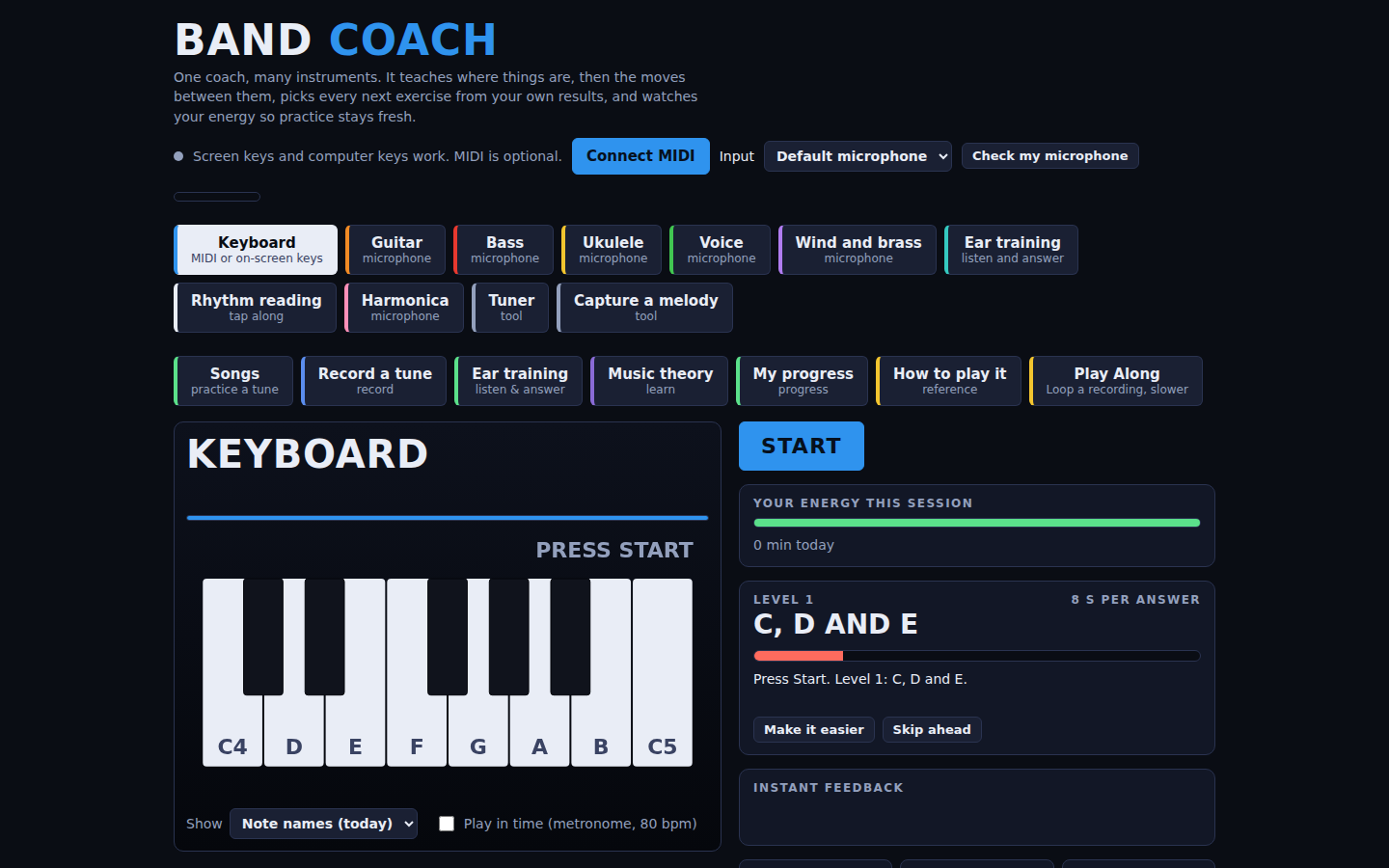
Pick an instrument, press Start, and Band Coach gives you notes or short phrases to play. Every answer updates a per-note memory score, so the next exercise is always whichever note or move that instrument’s model says you’re weakest on or haven’t touched in a while — never a fixed script, never dice. Knowledge fades if you stay away, so old material comes back into rotation on its own. A live energy meter tracks the session and offers a break rather than grinding on regardless.
Instruments
Seven instrument trainers listen live, each with its own graded curriculum:
| Instrument | Input |
|---|---|
| Keyboard | MIDI keyboard, on-screen keys, or the computer keyboard |
| Guitar | microphone |
| Bass | microphone |
| Ukulele | microphone |
| Voice | microphone |
| Wind and brass | microphone — pick your family so written notes match what you read |
| Harmonica | microphone |
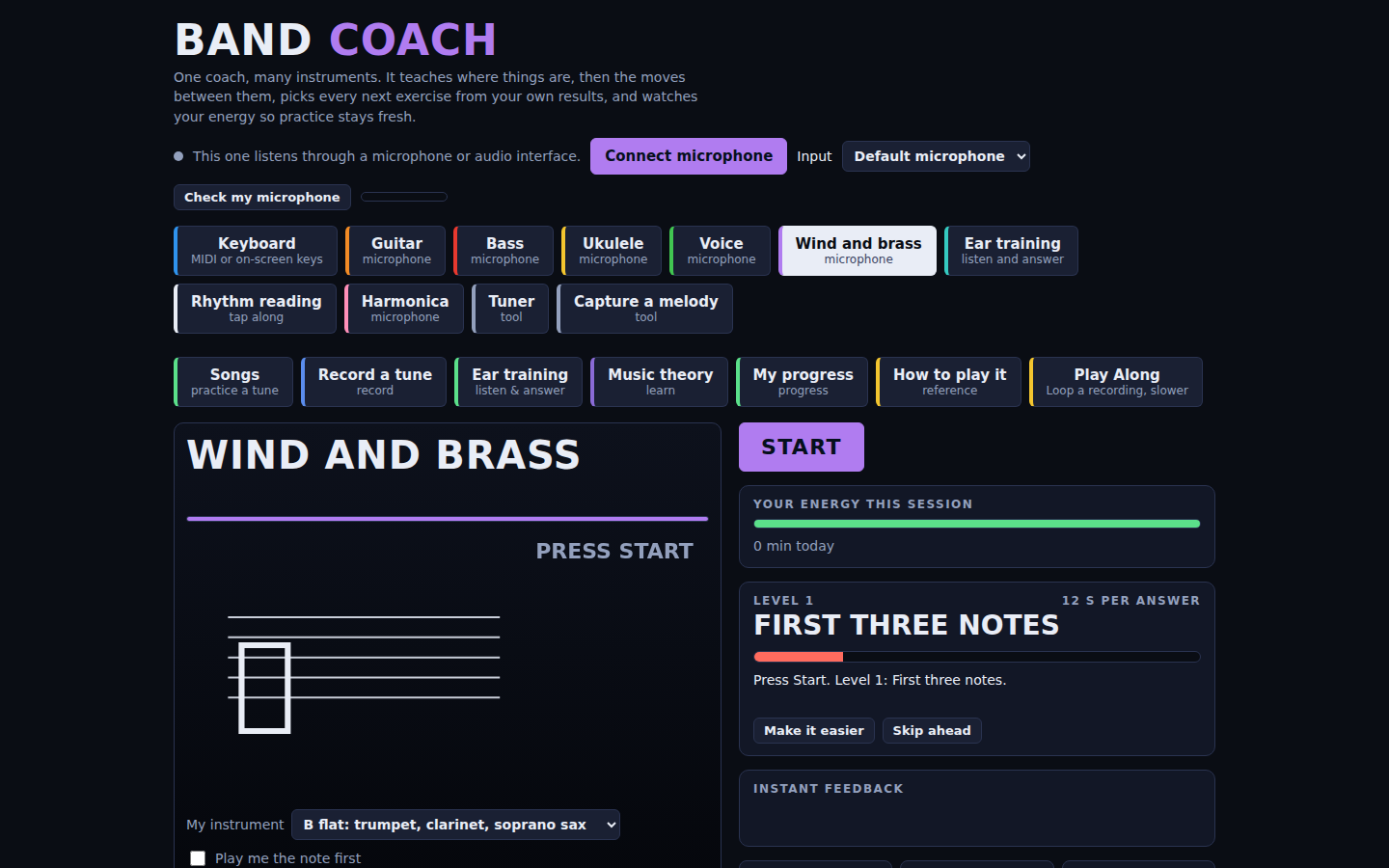
Guitar, bass and ukulele hear the pitch you play, not which string you used, so any fingering that lands on the right note counts. Chord listening on those three is experimental — a microphone hears a chord as one blended sound rather than separate notes, and a noisy room can fool it either way. Keyboard, guitar, bass, ukulele and voice can each show the note as a name, on a music staff, or both.
Alongside the seven instruments sit two more graded trainers that use the same Start-button screen: a quick Ear training mode (intervals and chords, played and picked from a list of answers) and Rhythm reading (read a printed bar, then tap it back on the space bar, a big pad, or any key on a connected MIDI instrument — marks under the notes show each tap green on time, yellow early or late, red missed).
Beyond the trainer
Seven more screens sit behind the second row of buttons:
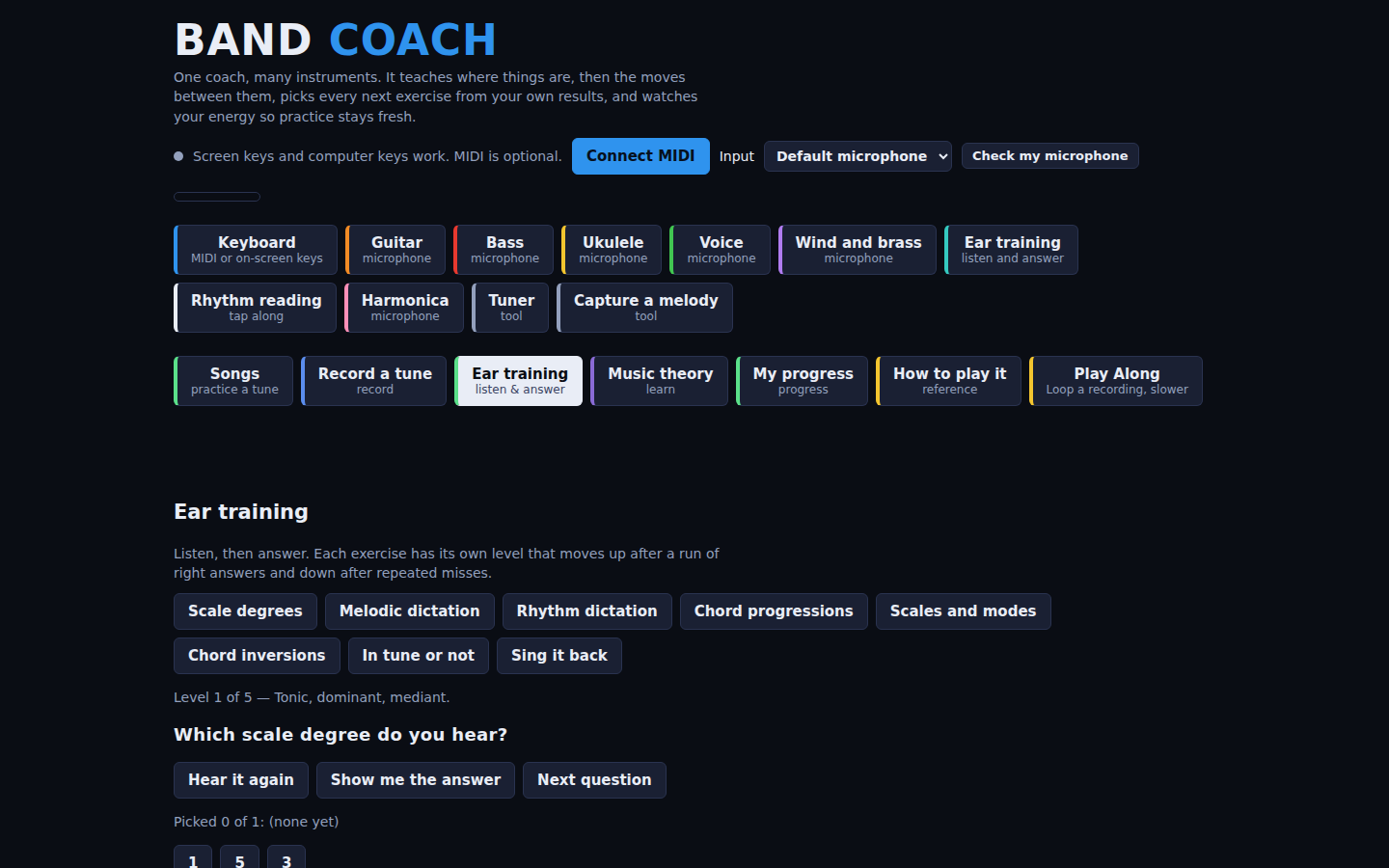
Ear training — a deeper set of eight ear-training exercises, separate from the quick mode above: scale degrees, melodic dictation, rhythm dictation, chord progressions, scales and modes, chord inversions, singing back what you hear, and judging whether a note is in tune — the last two use the microphone to check what you actually sang or played.
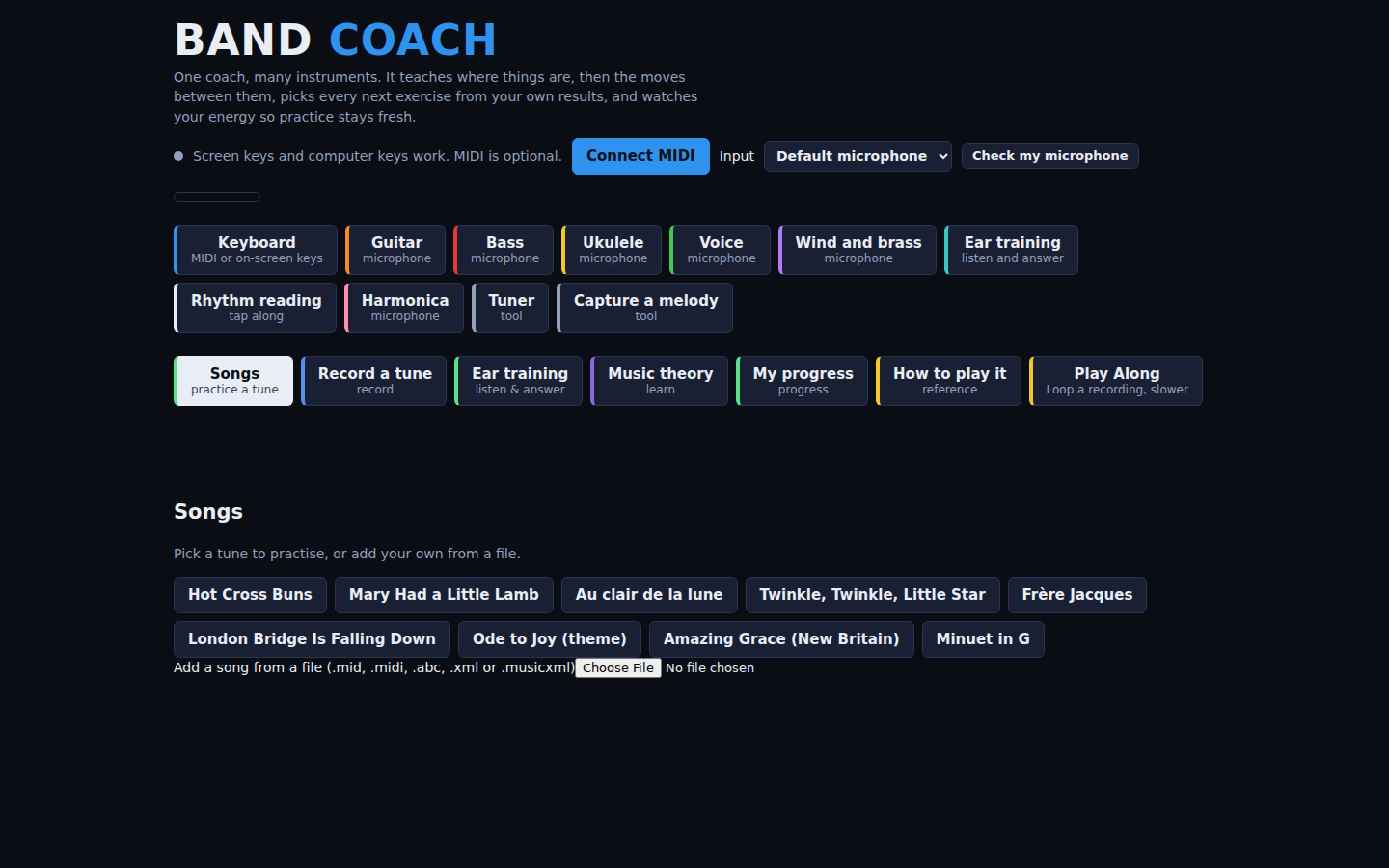
Songs — practise a real tune instead of a graded drill. Nine tunes ship with the app; you can also load your own from a MIDI, ABC or MusicXML file.
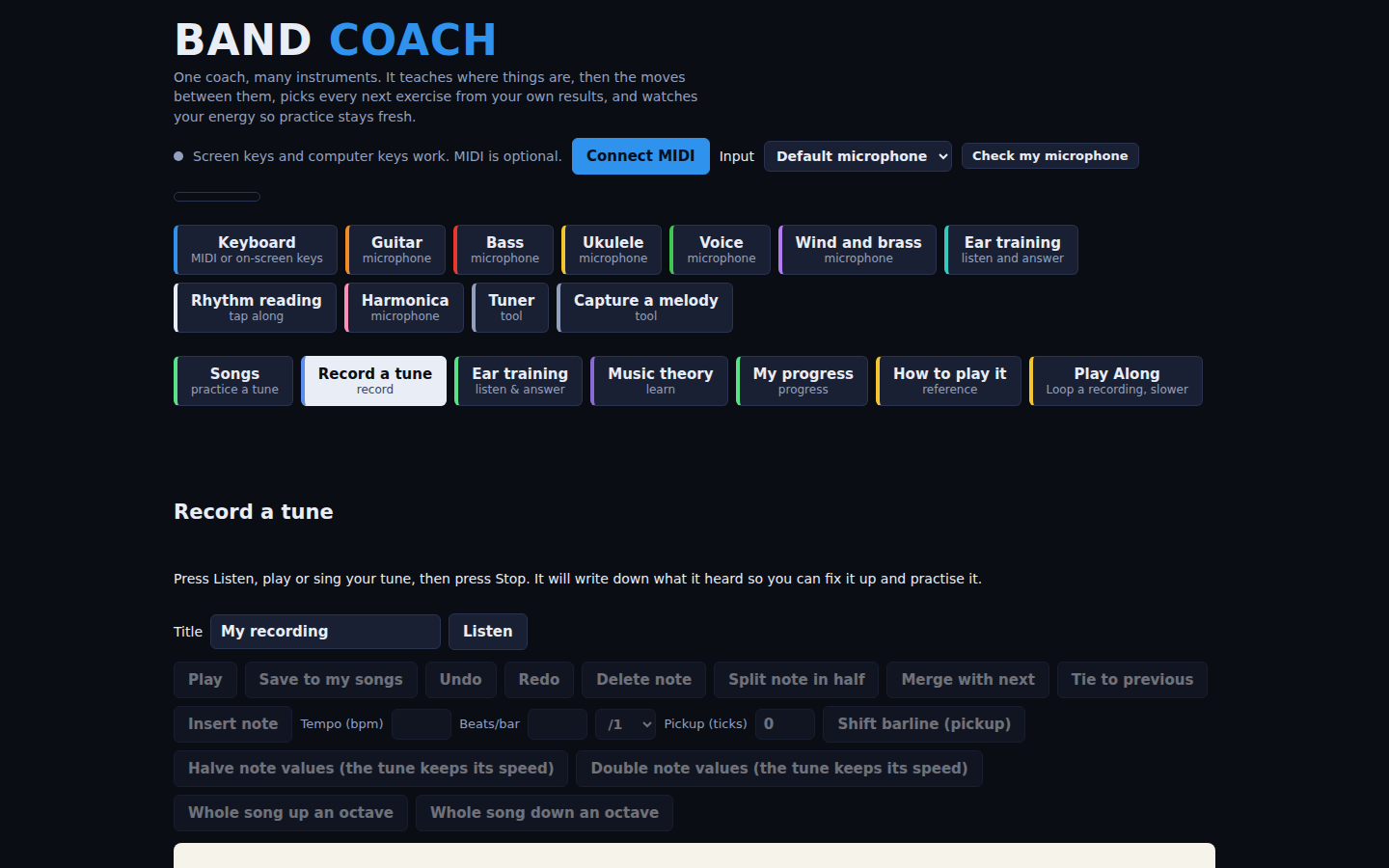
Record a tune — play, sing or hum into the microphone and it transcribes what it heard into editable notes: delete, split, merge, tie, retime or shift the whole thing an octave, then save it to Songs and practise it like any other tune.
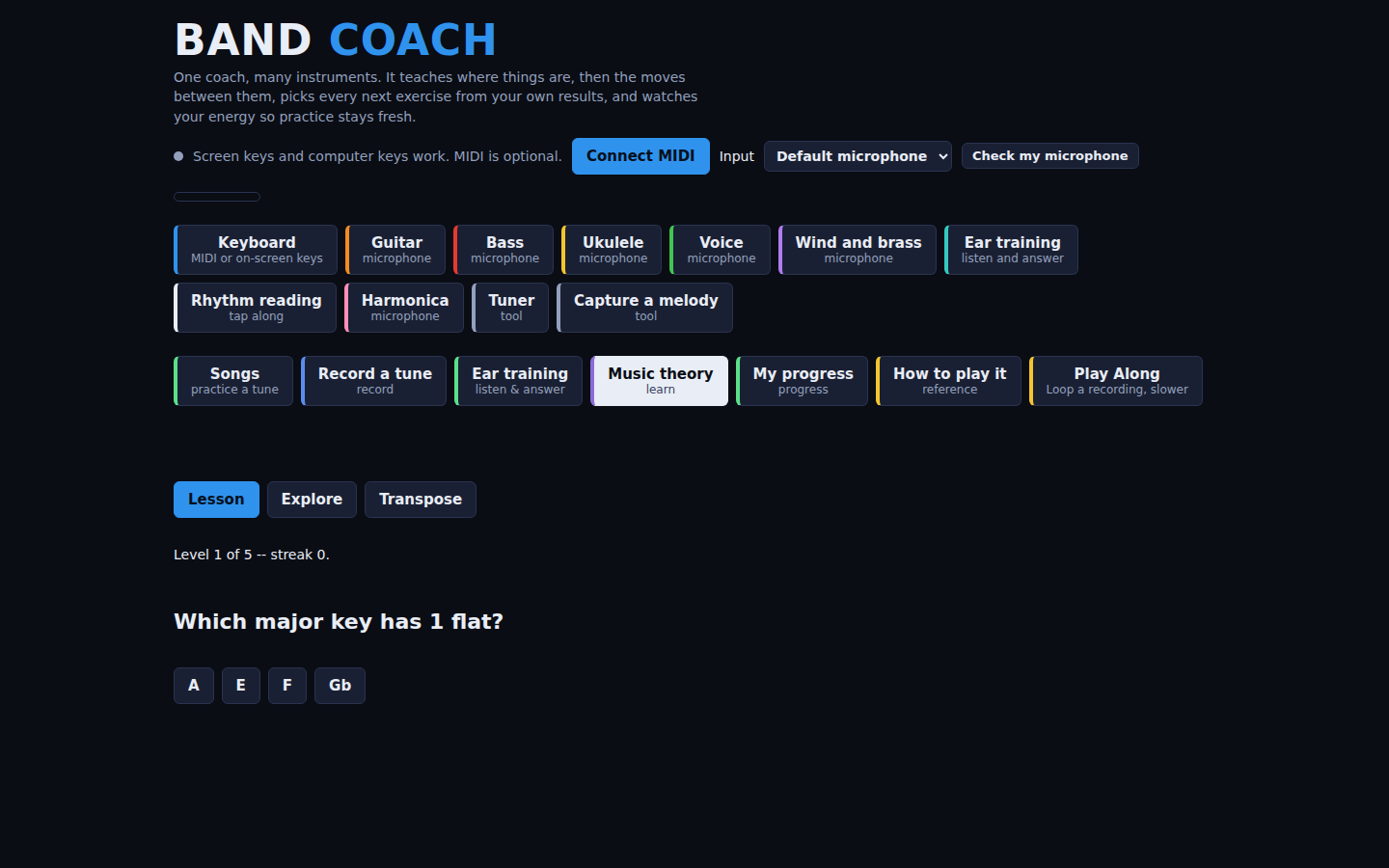
Music theory — a graded lesson track (keys, scales, chords), an Explore tab for looking up any key/scale/chord and hearing or seeing it on a staff and on your instrument, and a Transpose tab for written versus concert pitch.
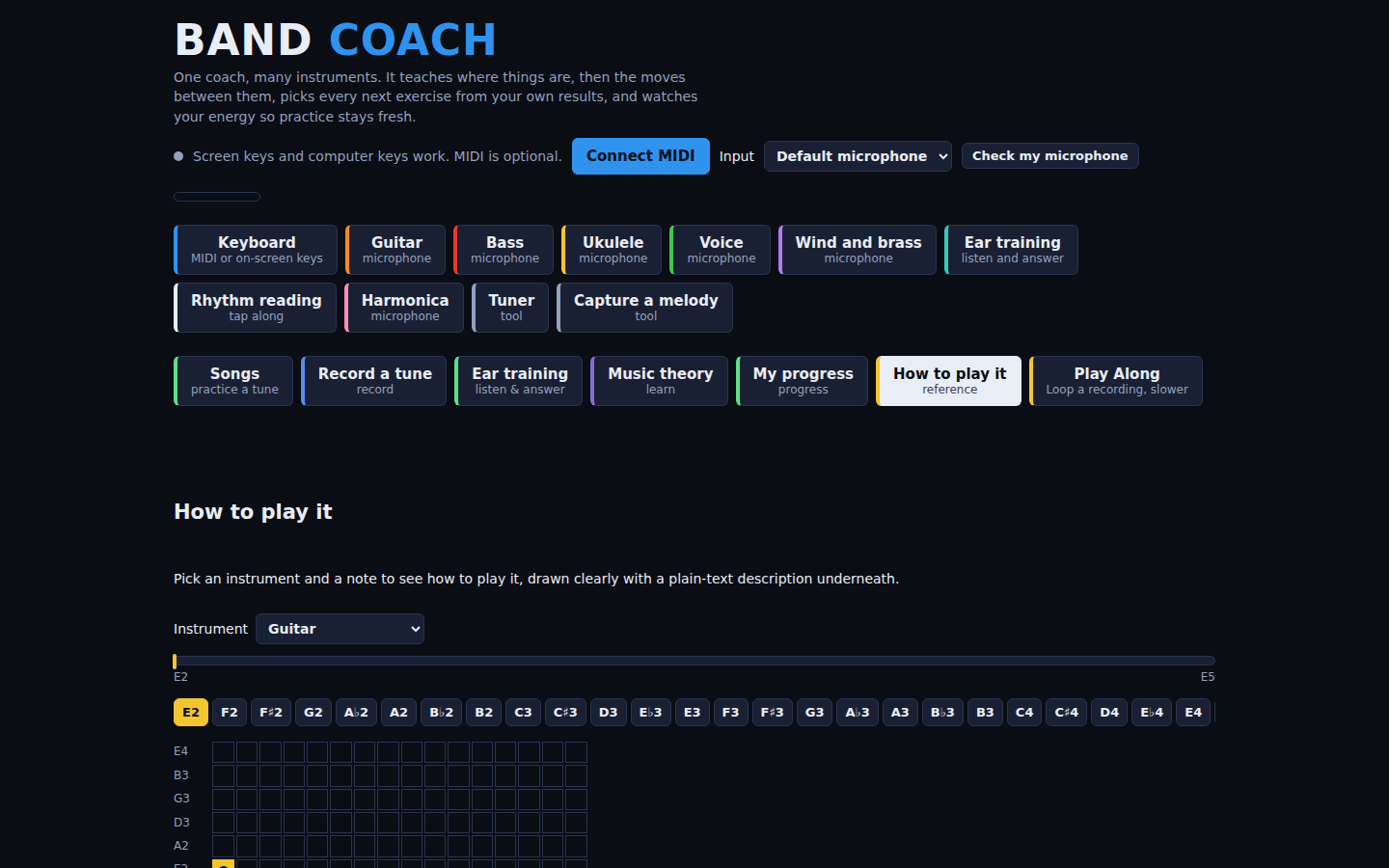
How to play it — pick an instrument and a note and see how to sound it: a fretboard for guitar, bass and ukulele, a fingerboard for the fretless strings, a valve or slide diagram for brass, a hole chart for harmonica and recorder-family instruments, plus a plain-text description for screen readers.
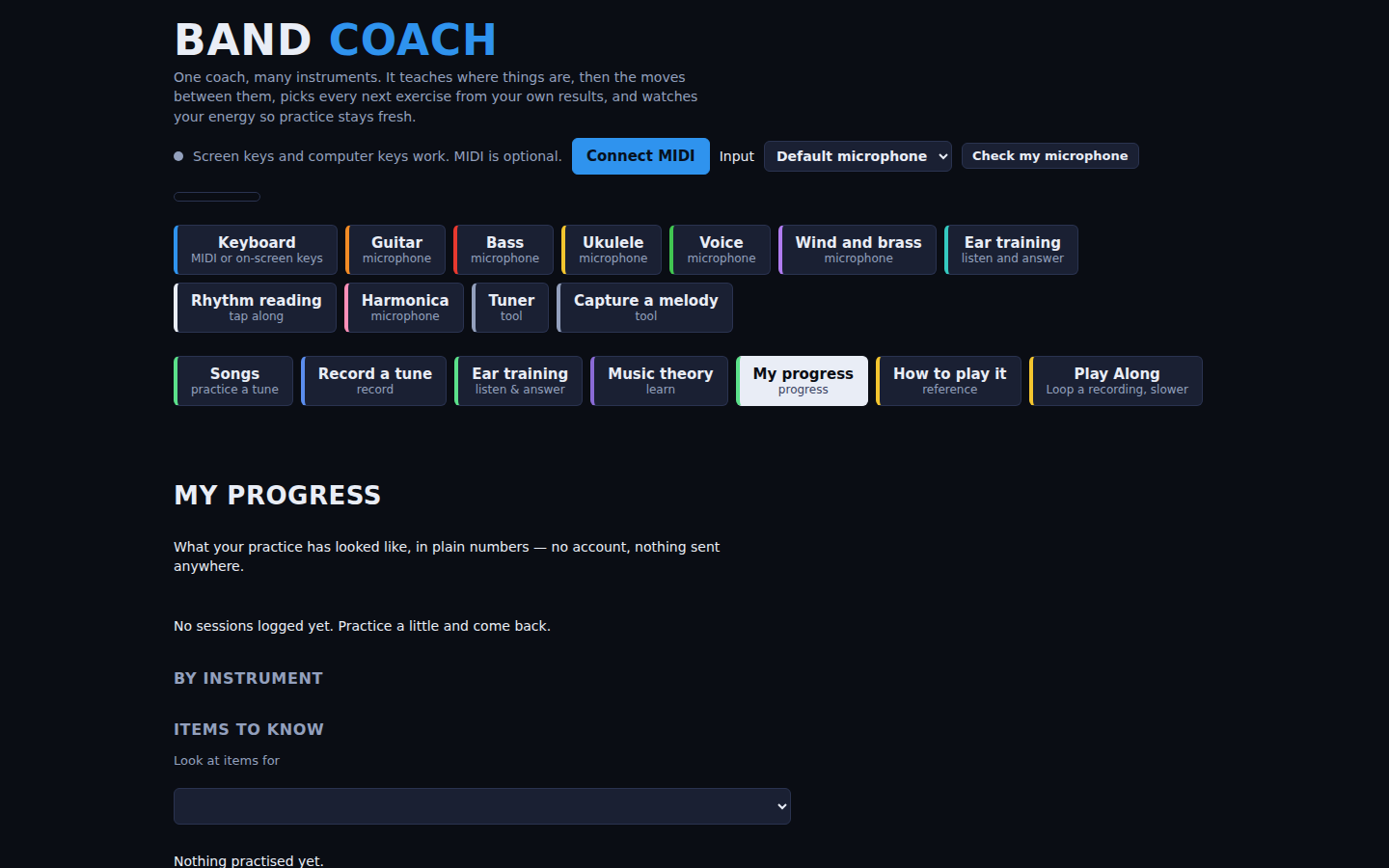
My progress — a plain-numbers report of what practice has looked like: sessions over time, strongest and weakest items per instrument, and a one-click “copy a summary for my teacher” report. Nothing here is sent anywhere; it is read straight out of the same local save file everything else uses.
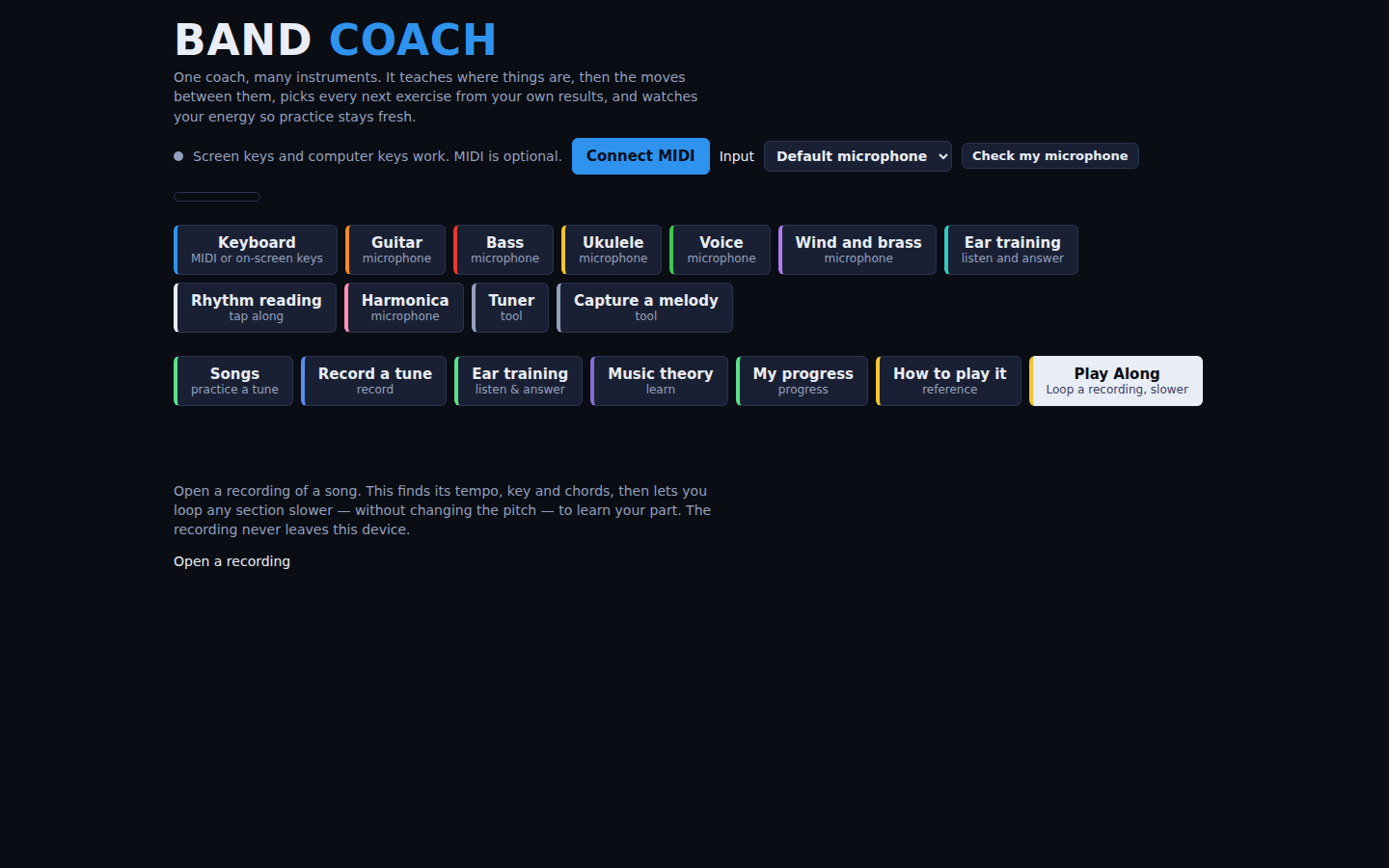
Play Along — open an audio recording of a song and Band Coach works out its tempo, key and chords, then lets you loop any section slower, without changing its pitch, to learn your part. The recording never leaves the device.
Two smaller tools live in the instrument picker alongside the trainers: a Tuner (needle and a per-string reference tone) and Capture a melody (hums or single notes get written down, and turned into a practice lesson on any listening instrument).
Works on your phone too
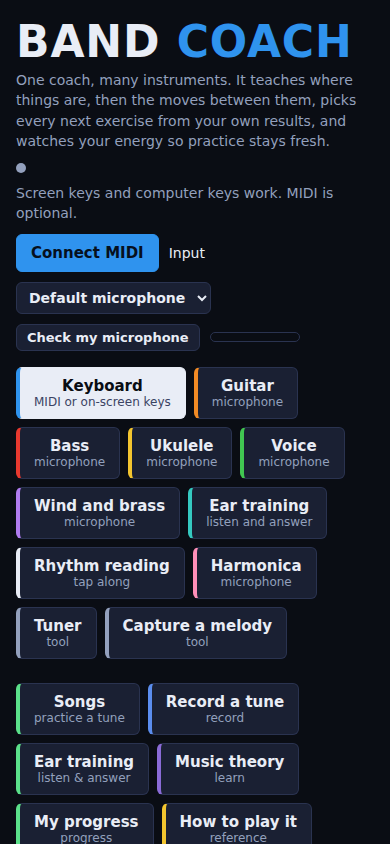
Band Coach’s layout runs down to a 360px-wide screen. It can also be installed as a phone app — “Add to Home Screen” — from back-road-creative.github.io/band-coach, a separate, free copy built from the exact same release. iPhone microphone behaviour under that installed copy hasn’t been measured on a real device yet, so treat it as one to try rather than one guaranteed to work there.
Getting it running
- Download the file
- Double-click it
- Allow the microphone, or connect a MIDI keyboard
That’s the entire setup. There is nothing to install and no account to create. Progress is saved
in the browser, tied to the exact file path Band Coach was opened from — moving or re-downloading
the file can lose it, so use “Save a backup” in the app to export band-coach-progress.json, and
“Restore a backup” to load one back in.
Requirements
Chrome or Edge, on Windows, Mac, Linux or a Chromebook. Web MIDI does not work in Safari, so Safari users should open the file in Chrome or Edge instead.
What it can’t hear
Band Coach hears pitch and timing. It cannot see posture, breath, bowing or hand position — use a teacher or video for those.
Free. No account. Your sound never leaves your computer.
Band Coach runs entirely in the browser tab you opened it in and makes no network calls at all — there is no server it talks to, nothing to sign up for, and nothing to pay for. It’s published under the Apache-2.0 licence; the source is on GitHub.
Documentation
Band Coach’s documentation lives in its repository, next to the code it describes — the README is the manual.